ARTISTS

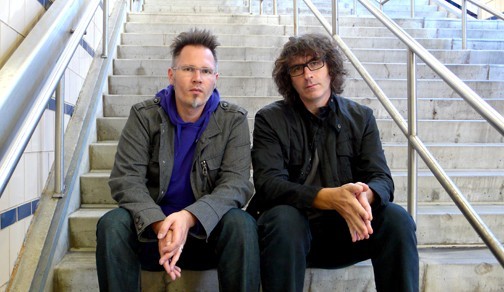
TIM MOTZER + MARKUS REUTER


Tim Motzer and Markus Reuter began working together on various projects starting in 2008. The first sessions were largely based around soundscaping and looping. Later these session would turn into the full blown Descending album.  They also, have played together in the Philly-based group Gojjo, although no albums exist yet, you can hear some live performances at myspace.

This year they have further collaborated on the upcoming TUNER album, tentitively titled FACE which features drummer, Pat Mastelotto. 60-70 hours marks Motzer intensive guitar tracking alone, and that makes up only a small bit of this large scale Reuter work coming in late 2011.

No doubt TM+MR duo and other configurations will continue working together into the future. A Motzer-Reuter duo webcast is being planned for late September 2010.

markus reuter,tim motzer

Tim Motzer & Markus Reuter - Descending (1k018)
Descending began as an ambient duo project between Motzer and German touch guitarist/composer/producer Markus Reuter (Tuner, Centrozoon, The Season Standard). Reuter came to Philadelphia in 2008 after an initial meeting in Munich while Motzer was on tour. Working with baritone and touch guitars, loopers and electronics, Motzer & Reuter created ethereal soundscapes during sessions at 1k recording studio and for an in-studio radio broadcast.   Later, Motzer invited UK flautist Theo Travis to contribute to the project. The two played on Nine Horses-Snow Borne Sorrow album by Sylvian, Friedman, and Steve Jansen. Travis, who tours with Robert Fripp and GONG, added beautiful flute melodies and chordal loops to “1200 Sundays”, and the haunting glitch guitars of “Emanuella”.  Enter another British musician, BJ Cole, lauded by Sting as “the worlds greatest steel pedal player”. His gorgeous work unfolds wonderful textures, densities, and mysterious layers of melodies to “We Were”, “Sound of the Sun”, “Ritual Observance”, and “Descending”. King Crimson drummer Pat Mastelotto recorded electronic percussion between his furiously hectic schedule with Stickmen and Allan Holdsworth. Additional spatial cymbals and metals were added by drummer Doug Hirlinger (BASE3).

Descending is a deeply sublime and stunningly beautiful work revealing more with each listen. Timeless and infinitely rich, Descending will certainly appeal to fans of Brian Eno, Frippertronics, Supersilent, and Sylvian (with whom four of the musicians on this album have worked)

----


Tim Motzer & Markus Reuter - Descending (1K recordings)

Any small amount of research on Tim Motzer reveals a wide scope of possible musical landscapes. This Philadelphia-based guitarist and composer has played on projects and tours with King Britt, Ursla Rucker, David Sylvian, Burnt Friedman and Jaki Liebezart as well as created numerous solo projects and a string of remixes and film scores under his belt. On Descending he plays guitar and electronics along with Markus Reuter on Touch Guitar and electronics. They are joined by alto flautist Theo Travis, a touring musician for Robert Fripp and Gong. As well there is the pedal steel guitarist BJ Cole a who has made contributions to the work of The Orb, Brian Eno, KLF, Squarepusher and Luke Vibert, to name a few of the exhaustive list of artists he has worked with. This perfunctory introduction to the work is a chore that somehow was needed as it is evidence to the depth of the skill and sheer volume of work that these four musicians have accumulated.

Anyone familiar with the work of any of them might consider this album under the general rubric of progressive or ambient, both of which give a general opening. However, a clearer analogy may consider it as pointillist or impressionist sound landscapes where the minute and intricate expressions all combine in a whole rendering both an impression unavailable by examination of the parts. The base of the work revolves around soundscaping and looping, on which the instrumentation, additions and flourishes act as foreground. It creates in its expression an atmosphere and complex space for Motzer and Reuter’s guitar and electronic soundscapes which move between glitch and bright ambience. None of the parts would seem to impress or dominate the space but convey in their interplay a complex and cerebral space. The residual traces of musical forms from jazz, classical and progressive rock filter through the playing, yet it resides as a form of shimmering guitar glitch ambience. At times the guitars extract metallic forms, shrill and harsh yet without the dense visceral power of industrial music, although they suggest its general area. It often has the sense of being a composed piece for cinema, as the atmospheric tendencies of the album lead to this, in the vein of Vangelis’s score for Blade Runner, amorphous and suggesting a complex ambiguous future. The boundary here between the idea of composition, experimentation and improvisation has seemed to be collapsed into a fluid expression of contemporary sound art.

Innerversitysound